Hair loss

18.09.2025
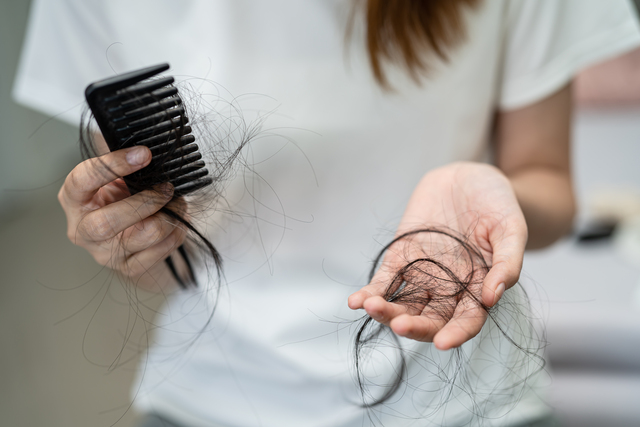
Hair loss (also known scientifically as alopecia) is the loss of hair from the scalp or other parts of the body where hair normally grows.
Hair loss can be caused by a variety of factors – genetics, hormonal changes, stress, diet, vitamin/mineral deficiencies, scalp diseases or certain medications.
The best solution depends on the cause, so it makes sense to consult a doctor or dermatologist first.
🧠 What is normal hair loss?
We lose about 50-100 hairs every day, which is completely normal. Hair has a natural life cycle:
- Anagen phase – growth (lasts several years)
- Catagen phase – transition phase (a few weeks)
- Telogen phase – resting phase (3-4 months), then the hair falls out
After this cycle, a new hair starts to grow from the same hair root.
⚠️ When is excessive hair loss?
When more than 100 hairs are lost per day and this is noticed as:
- visible thinning of hair,
- bald patches,
- clogged drains after combing or washing,
- hair left on the pillow.
📂 Main forms of hair loss:
Type of loss Characteristics
Telogenous effluvium Diffuse loss over the entire scalp; often after stress, illness, childbirth or diet.
Androgenic alopecia Genetically caused loss (male or female pattern baldness). Gradual thinning.
Alopecia areata Circular loss – round bald patches, autoimmune cause.
Traction alopecia Due to hair pulling (tight hairstyles, extensions).
Cicatricial alopecia Rarer, scarring hair loss, where hair does not grow back.
Most common causes:
Genetics
- Most common cause in men and women.
- Male pattern baldness: hair recedes from the temples and crown.
- Female pattern: thinning over the entire surface of the scalp, especially on the crown.
🧠 Stress
- Physical or emotional stress can trigger telogen effluvium – sudden, diffuse hair loss.
- It often occurs 2–3 months after a stressful event (illness, surgery, loss of a loved one, etc.).
🥗 Nutrition and nutritional deficiencies
- Deficiencies in iron, zinc, vitamin D, protein or B vitamins (e.g. B12) can cause hair loss.
- Very restrictive diets or eating disorders are common triggers.
🔁 Hormonal changes
- Pregnancy, childbirth, menopause, polycystic ovary syndrome (PCOS), thyroid problems (hypo-/hyperthyroidism).
- Postpartum hair loss is usually temporary.
💊 Medications
- Chemotherapy, antidepressants, blood pressure medications, retinoids, thyroid medications.
- Hair loss can be a side effect and often subsides after stopping therapy.
🦠 Diseases and infections
- Autoimmune diseases (e.g. alopecia areata – ring-shaped hair loss).
- Fungal infections of the scalp (e.g. tinea capitis).
- Systemic diseases (lupus, diabetes, etc.).
🧴 External damage to the hair
- Frequent use of aggressive chemical treatments (bleaching, permanent waving, coloring).
- Pulling hair into tight hairstyles (e.g. ponytails, braids).
What you can do:
- Blood tests (iron, thyroid hormones, vitamin D, B12).
- Consultation with a dermatologist or trichologist (hair specialist).
- Balanced diet, hair care without aggressive products, reducing stress.
- If hair loss is severe or long-lasting, see a doctor.
👉 If hair loss is sudden, very severe, or accompanied by other symptoms (e.g. fatigue, brittle nails, skin changes), a doctor’s examination is necessary, as it may be a sign of hormonal disorders (thyroid, hormones), nutrient deficiencies, or other diseases.